Introduction
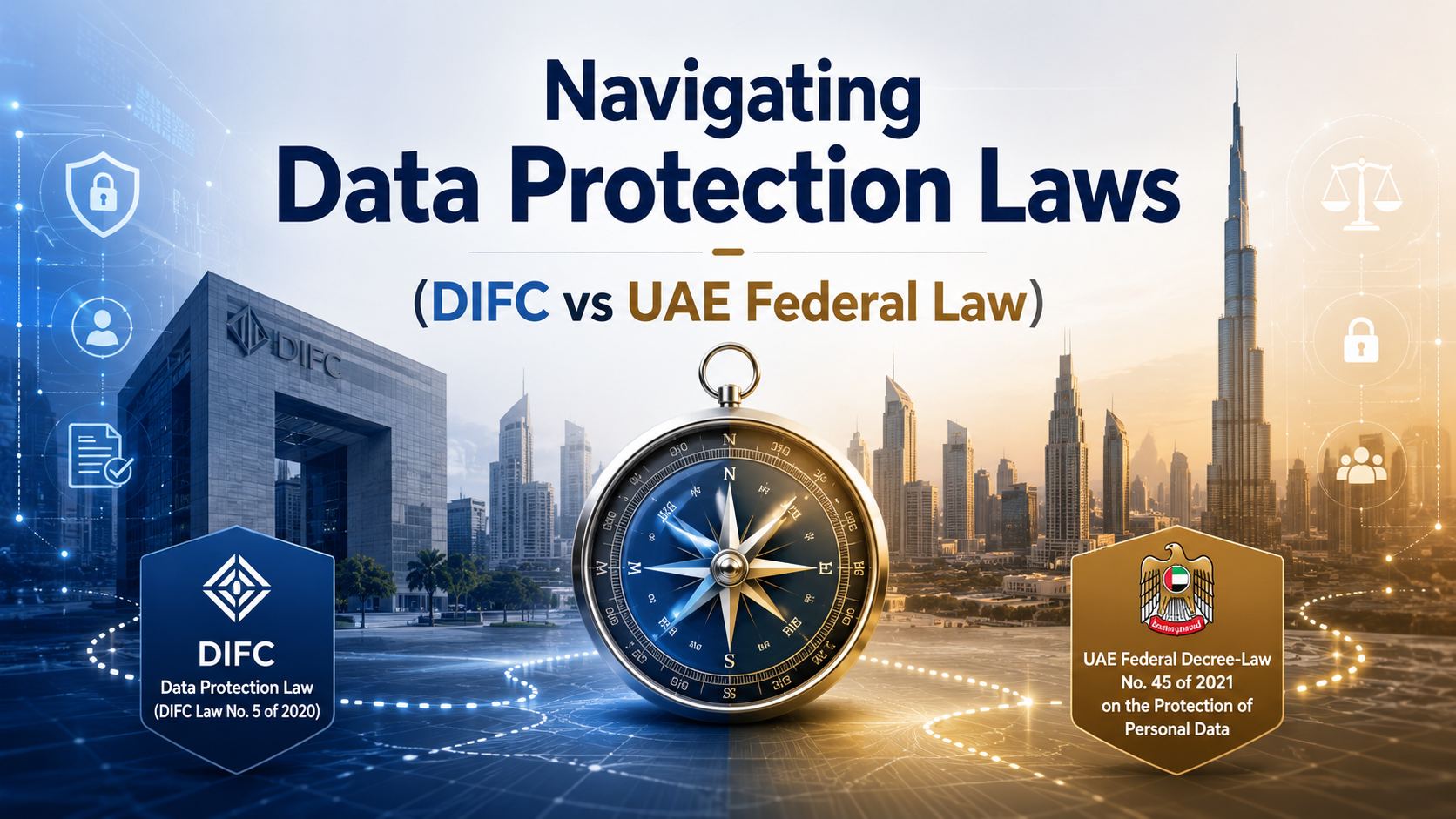
Data protection has become a strategic business priority across the United Arab Emirates. Organizations operating within the UAE increasingly face obligations under multiple privacy frameworks, particularly the Dubai International Financial Centre (DIFC) Data Protection Law and the UAE Federal Personal Data Protection Law (PDPL).
While both frameworks aim to protect personal information and promote responsible data handling, they differ significantly in jurisdiction, regulatory structure, enforcement mechanisms, and operational requirements.
Understanding these distinctions is essential for businesses, multinational corporations, financial institutions, technology companies, healthcare organizations, and professional services firms operating in or connected to the UAE.
Featured Snippet Answer
What is the difference between DIFC Data Protection Law and UAE Federal PDPL?
The DIFC Data Protection Law applies primarily to entities operating within the Dubai International Financial Centre, while the UAE Federal Personal Data Protection Law (PDPL) applies across the UAE outside certain financial free zones. The DIFC framework is modeled closely on international privacy standards and contains detailed provisions regarding lawful processing, accountability, data subject rights, and international transfers. The Federal PDPL establishes a nationwide privacy regime and applies broadly to personal data processing activities conducted within the UAE, subject to specific exemptions.
Key Takeaways
- DIFC Data Protection Law applies primarily within the DIFC jurisdiction.
- UAE PDPL serves as the federal privacy framework for much of the UAE.
- Both laws regulate the processing of personal data.
- Organizations must assess which law applies based on location, activities, and data flows.
- Cross-border data transfers require additional compliance considerations.
- Data subject rights are recognized under both frameworks.
- Privacy governance and accountability are central compliance obligations.
- Non-compliance may result in regulatory action and reputational consequences.
Understanding UAE Data Protection Frameworks
The UAE’s privacy landscape includes multiple regulatory frameworks designed to protect personal information while supporting economic growth and digital innovation.
Key privacy regimes include:
- UAE Federal Personal Data Protection Law (PDPL)
- DIFC Data Protection Law
- Other sector-specific requirements
- Free zone regulations where applicable
Organizations frequently need to determine whether one or multiple frameworks apply simultaneously.
DIFC Data Protection Law Overview
The DIFC Data Protection Law was developed to align with internationally recognized privacy principles.
Core objectives include:
- Protection of individual privacy rights
- Transparency in data processing
- Accountability of organizations
- Secure international data transfers
- Risk-based compliance governance
The framework applies primarily to entities established within the DIFC and certain processing activities connected to the DIFC.
Key Principles
- Lawfulness
- Fairness
- Transparency
- Purpose limitation
- Data minimization
- Accuracy
- Storage limitation
- Security
- Accountability
UAE Federal PDPL Overview
The UAE Federal Personal Data Protection Law establishes a nationwide privacy framework governing the processing of personal data.
Primary goals include:
- Strengthening individual privacy protections
- Establishing data governance standards
- Supporting digital transformation
- Facilitating international business confidence
- Encouraging responsible innovation
The PDPL generally applies to organizations processing personal data within the UAE, subject to statutory exclusions and sector-specific rules.
Comparison Table: DIFC vs UAE Federal PDPL
| Category | DIFC Data Protection Law | UAE Federal PDPL |
|---|---|---|
| Primary Scope | DIFC entities and activities | Federal UAE jurisdiction |
| Regulatory Authority | DIFC Commissioner of Data Protection | Federal regulatory authorities |
| International Influence | Strong alignment with global privacy principles | UAE-wide privacy framework |
| Data Subject Rights | Extensive rights framework | Recognized privacy rights |
| Cross-Border Transfers | Detailed transfer mechanisms | Transfer requirements apply |
| Compliance Governance | Strong accountability requirements | Risk-based compliance obligations |
| Enforcement | DIFC-specific enforcement powers | Federal enforcement mechanisms |
What Constitutes Personal Data?
Both frameworks broadly regulate information relating to identifiable individuals.
Examples include:
- Names
- Email addresses
- Phone numbers
- Identification numbers
- Online identifiers
- Location data
- Employment information
- Financial information
- Customer records
Certain categories of sensitive information may receive enhanced protection.
Lawful Bases for Processing
Organizations generally require a lawful basis before processing personal data.
Common grounds may include:
| Processing Basis | Typical Example |
|---|---|
| Consent | Marketing communications |
| Contractual Necessity | Service delivery |
| Legal Obligation | Regulatory reporting |
| Legitimate Interests | Business operations where permitted |
| Public Interest | Government-related functions |
Organizations should carefully document the legal basis relied upon for each processing activity.
Data Subject Rights
Individuals may possess rights relating to their personal information.
These commonly include:
- Access requests
- Correction requests
- Data portability rights
- Objection rights
- Restriction rights
- Deletion rights (where applicable)
- Withdrawal of consent
The precise scope and implementation requirements depend on the applicable legal framework.
Cross-Border Data Transfers
Cross-border transfers represent one of the most significant compliance considerations.
Organizations transferring personal information outside applicable jurisdictions should evaluate:
- Destination country protections
- Contractual safeguards
- Organizational controls
- Regulatory requirements
- Transfer impact assessments where appropriate
International businesses often require structured transfer governance programs.
Compliance Requirements for Businesses
Organizations should establish comprehensive privacy governance programs.
Key compliance measures include:
Governance
- Privacy policies
- Data inventories
- Processing records
- Internal controls
Security
- Access controls
- Encryption where appropriate
- Incident response procedures
- Vendor oversight
Accountability
- Compliance monitoring
- Employee training
- Risk assessments
- Documentation practices
Vendor and Third-Party Management
Third-party processing arrangements present substantial privacy risk.
Organizations should evaluate:
| Vendor Assessment Area | Key Questions |
|---|---|
| Security Controls | Are safeguards documented? |
| Data Handling | How is data processed? |
| Subprocessors | Are additional vendors involved? |
| Incident Response | How are breaches managed? |
| Transfer Risks | Is data transferred internationally? |
Appropriate contractual protections are often critical.
Data Breach Management
Effective incident response plans should address:
- Detection
- Containment
- Investigation
- Documentation
- Notification obligations
- Remediation
Organizations should establish clear escalation procedures before an incident occurs.
Common Compliance Challenges
Businesses frequently encounter challenges such as:
- Unclear data inventories
- Legacy systems
- Cross-border transfers
- Vendor oversight
- Consent management
- Record-keeping deficiencies
- Multi-jurisdictional operations
Addressing these issues proactively can reduce regulatory and operational risk.
Risk Comparison Table
| Risk Area | DIFC Focus | Federal PDPL Focus |
|---|---|---|
| Governance Failures | High scrutiny | Significant compliance concern |
| International Transfers | Major regulatory area | Important compliance obligation |
| Security Weaknesses | Potential enforcement risk | Potential enforcement risk |
| Vendor Oversight | Strong accountability expectations | Important governance responsibility |
| Rights Management | Operational requirement | Compliance requirement |
Best Practices for Multinational Organizations
Organizations operating across jurisdictions should consider:
- Enterprise-wide privacy governance.
- Unified data mapping.
- Consistent vendor assessments.
- Privacy-by-design implementation.
- Employee awareness training.
- Incident response readiness.
- Regular compliance reviews.
A harmonized compliance approach often reduces complexity and operational risk.
Frequently Asked Questions
1. Does the DIFC Data Protection Law apply outside the DIFC?
It may apply to certain processing activities connected to DIFC-regulated entities. Applicability depends on the facts and organizational structure.
2. Is the UAE PDPL similar to international privacy laws?
The PDPL incorporates several globally recognized privacy concepts, although it remains a distinct UAE legal framework.
3. Can a company be subject to both regimes?
In some circumstances, organizations with operations spanning multiple jurisdictions may need to consider obligations under more than one privacy framework.
4. Are employee records covered?
Employment-related data may be subject to privacy obligations, depending on the applicable law and context.
5. Do both laws regulate international transfers?
Yes. Cross-border transfers are a significant compliance area under both frameworks.
6. What are the biggest compliance risks?
Common risks include inadequate governance, weak security controls, poor documentation, and insufficient vendor oversight.
7. Is consent always required?
No. Consent is one possible lawful basis, but other legal grounds may also be available depending on the circumstances.
8. How often should organizations review privacy programs?
Periodic reviews are generally considered a best practice, particularly when business operations, technology, or regulatory expectations change.
Internal Linking Opportunities
Suggested related content:
- UAE Corporate Governance Requirements
- UAE Cybersecurity Compliance Guide
- Cross-Border Data Transfer Regulations
- Information Security Risk Management
- Privacy Impact Assessments Explained
- Vendor Due Diligence Best Practices
- Data Breach Response Planning
- UAE Technology and Digital Regulations
Conclusion
The DIFC Data Protection Law and the UAE Federal Personal Data Protection Law share the common objective of protecting personal information, yet they operate within distinct legal and regulatory environments. Businesses should carefully evaluate their operational footprint, data processing activities, vendor relationships, and international data flows to determine applicable obligations.
A proactive compliance strategy built on governance, accountability, transparency, and security can help organizations reduce regulatory risk while strengthening stakeholder trust.
Disclaimer
This article is provided for educational and informational purposes only and should not be considered legal advice. Data protection obligations vary based on organizational structure, processing activities, industry sector, and jurisdiction. Organizations should consult qualified legal and privacy professionals regarding specific compliance requirements.
Leave a Reply